<?xml version="1.0" encoding="utf-8"?><feed xmlns="http://www.w3.org/2005/Atom" ><generator uri="https://jekyllrb.com/" version="3.10.0">Jekyll</generator><link href="https://wrahool.github.io/feed.xml" rel="self" type="application/atom+xml" /><link href="https://wrahool.github.io/" rel="alternate" type="text/html" /><updated>2025-08-21T04:14:52-07:00</updated><id>https://wrahool.github.io/feed.xml</id><title type="html">Subhayan Mukerjee</title><subtitle>Ph.D. Candidate</subtitle><author><name>Subhayan Mukerjee</name><email>mail@subhayan.com</email></author><entry><title type="html">Special Issue on Generative AI in Computational Communication Research</title><link href="https://wrahool.github.io/posts/2024/11/ccr-genai-si/" rel="alternate" type="text/html" title="Special Issue on Generative AI in Computational Communication Research" /><published>2024-11-09T00:00:00-08:00</published><updated>2024-11-09T00:00:00-08:00</updated><id>https://wrahool.github.io/posts/2024/11/ccr-genai-si</id><content type="html" xml:base="https://wrahool.github.io/posts/2024/11/ccr-genai-si/"><![CDATA[<p><a href="https://cla.umn.edu/about/directory/profile/alvinyxz">Alvin Zhou</a>, <a href="https://media.illinois.edu/advertising/maslowska-ewa">Ewa Maslowska</a>, and I are guest-editing a special issue on ``Generative AI in Computational Communication Research’’ for the journal <a href="https://journal.computationalcommunication.org/">Computational Communication Research</a>. The special issue aims to bring together cutting-edge research that either focuses on generative AI as a communication phenomenon, or substantively uses generative AI to study communication processes. The full call for papers can be found <a href="https://z.umn.edu/ccrgenai">here</a>.</p>

<p>Extended abstracts are due 31 December 2024. Full papers for shortlisted abstracts will be due for peer review on 30 April 2025.</p>

<p>Spread the word!</p>]]></content><author><name>Subhayan Mukerjee</name><email>mail@subhayan.com</email></author><category term="genAI" /><category term="computational methods" /><category term="call for papers" /><summary type="html"><![CDATA[Alvin Zhou, Ewa Maslowska, and I are guest-editing a special issue on ``Generative AI in Computational Communication Research’’ for the journal Computational Communication Research. The special issue aims to bring together cutting-edge research that either focuses on generative AI as a communication phenomenon, or substantively uses generative AI to study communication processes. The full call for papers can be found here.]]></summary></entry><entry><title type="html">ICA Preconference in Computational Journalism</title><link href="https://wrahool.github.io/posts/2024/7/computational-journalism-preconf/" rel="alternate" type="text/html" title="ICA Preconference in Computational Journalism" /><published>2024-07-20T00:00:00-07:00</published><updated>2024-07-20T00:00:00-07:00</updated><id>https://wrahool.github.io/posts/2024/7/computational-journalism-preconf</id><content type="html" xml:base="https://wrahool.github.io/posts/2024/7/computational-journalism-preconf/"><![CDATA[<p>Last month, we successfully organised an <a href="https://fass.nus.edu.sg/cnm/ica-2024/">International Communication Association preconference titled “A Computational Turn in Journalism”</a>. This hybrid day-long event, hosted by the Faculty of Arts and Social Sciences of NUS, saw 30 presentations from scholars around the world over 3 sets of parallel sessions. We were also lucky to have two in-person keynotes by renowned experts studying the intersection of journalism and computation. See the full preconference program <a href="https://fass.nus.edu.sg/cnm/wp-content/uploads/sites/2/2024/06/Preconference-Program-Final_20240617.pdf">here</a>.</p>

<p>Some photos from the event below:</p>

<div class="image-caption-container">
  <img src="/assets/images/preconf1.jpg" alt="preconference 1" />
  <span>The program committee of the conference. From left: Yilang Peng (U of Georgia), Subhayan Mukerjee (NUS), Tian Yang (CUHK), Thorsten Quandt (U of Munster), and Shangyuan Wu (NUS)</span>
</div>

<div class="image-caption-container">
  <img src="/assets/images/preconf2.jpg" alt="preconference 2" />
  <span>Attendees at the event engaged in discussions</span>
</div>

<div class="image-caption-container">
  <img src="/assets/images/preconf3.jpg" alt="preconference 3" />
  <span>Edson Tandoc Jr (NTU) delivering his keynote</span>
</div>

<div class="image-caption-container">
  <img src="/assets/images/preconf4.jpg" alt="preconference 4" />
  <span>The ground organising team. From left: Shangyuan Wu, Subhayan Mukerjee, Rongxin Ouyang, Clara Shen, Nur Nadiah Bte Mohamed Hashim, Jo Anna Wong</span>
</div>

<div class="image-caption-container">
  <img src="/assets/images/preconf5.jpg" alt="preconference 5" />
  <span>Magdalena Wojcieszak (UC Davis) delivering her keynote</span>
</div>

<div class="image-caption-container">
  <img src="/assets/images/preconf6.jpg" alt="preconference 6" />
  <span>A full house of in-person attendees</span>
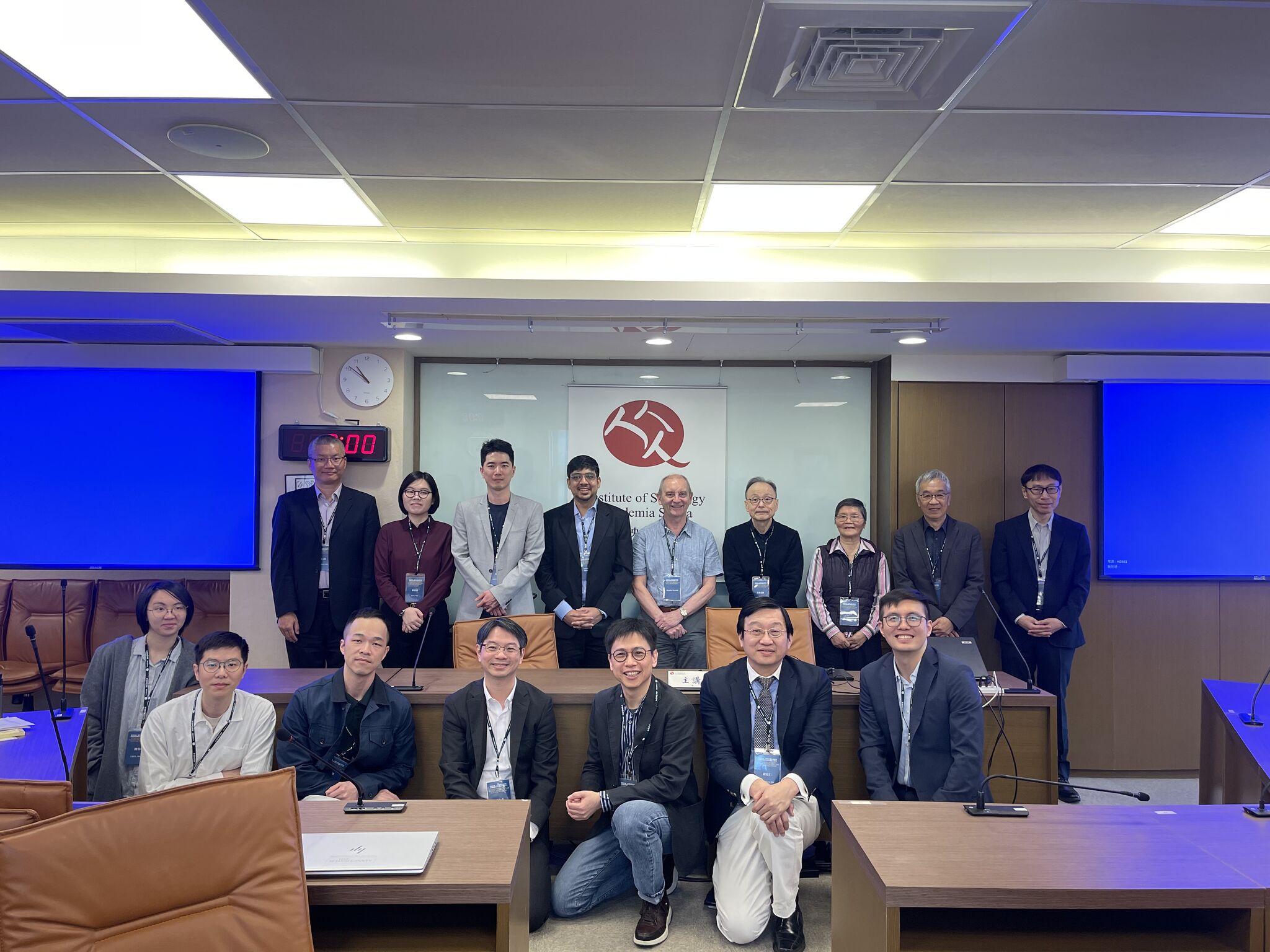
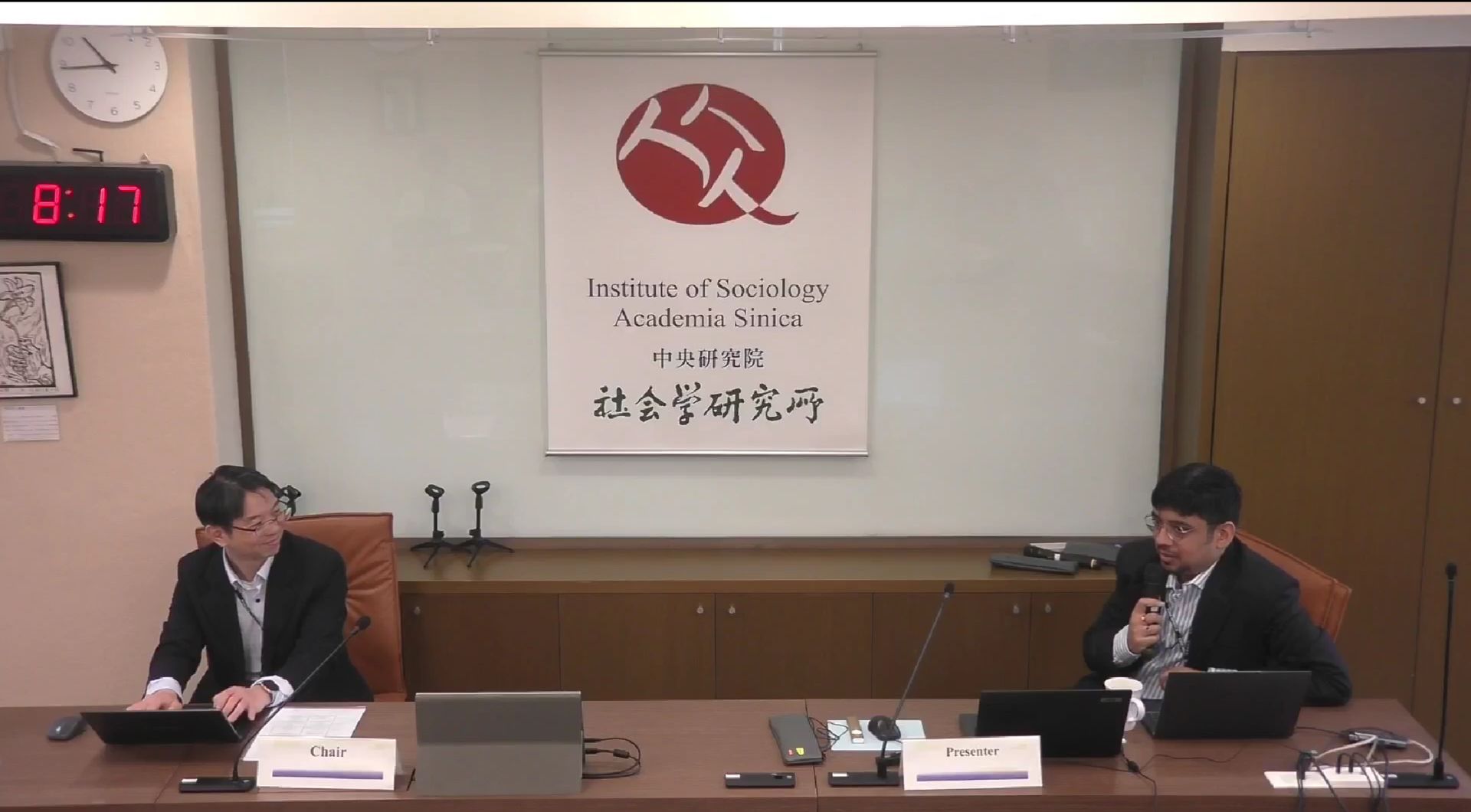
</div>]]></content><author><name>Subhayan Mukerjee</name><email>mail@subhayan.com</email></author><category term="social science" /><category term="journalism" /><category term="conference" /><category term="computational methods" /><summary type="html"><![CDATA[Last month, we successfully organised an International Communication Association preconference titled “A Computational Turn in Journalism”. This hybrid day-long event, hosted by the Faculty of Arts and Social Sciences of NUS, saw 30 presentations from scholars around the world over 3 sets of parallel sessions. We were also lucky to have two in-person keynotes by renowned experts studying the intersection of journalism and computation. See the full preconference program here.]]></summary></entry><entry><title type="html">Invited Lecture at Academia Sinica, Taiwan</title><link href="https://wrahool.github.io/posts/2024/3/computing-society-taiwan/" rel="alternate" type="text/html" title="Invited Lecture at Academia Sinica, Taiwan" /><published>2024-03-29T00:00:00-07:00</published><updated>2024-03-29T00:00:00-07:00</updated><id>https://wrahool.github.io/posts/2024/3/computing-society-taiwan</id><content type="html" xml:base="https://wrahool.github.io/posts/2024/3/computing-society-taiwan/"><![CDATA[<p>I was invited to a workshop titled <a href="https://www.ios.sinica.edu.tw/workshop.php?id=21">“Computing Society”</a> held at the Institute of Sociology of Academia Sinica, Taiwan to deliver a talk about my research in particular and the future of computational social science in general. My talk was titled “Informational Asymmetries in the Production and Consumption of Digital Media” (<a href="https://www.subhayan.com/assets/files/Subhayan_Academia-Sinica.pdf">slide deck</a> / <a href="https://www.facebook.com/iosacademiasinica/videos/929475851972410/?app=fbl">recording (from around 50 minutes)</a>).</p>

<p>It was my first time visiting Taiwan, and I had a lovely couple of days there, and met some wonderful new colleagues. I hope to go back very soon!</p>

<p><img src="/assets/images/sinica-1.jpg" alt="Computing Society 1" /></p>

<p><img src="/assets/images/sinica-2.jpg" alt="Computing Society 2" /></p>

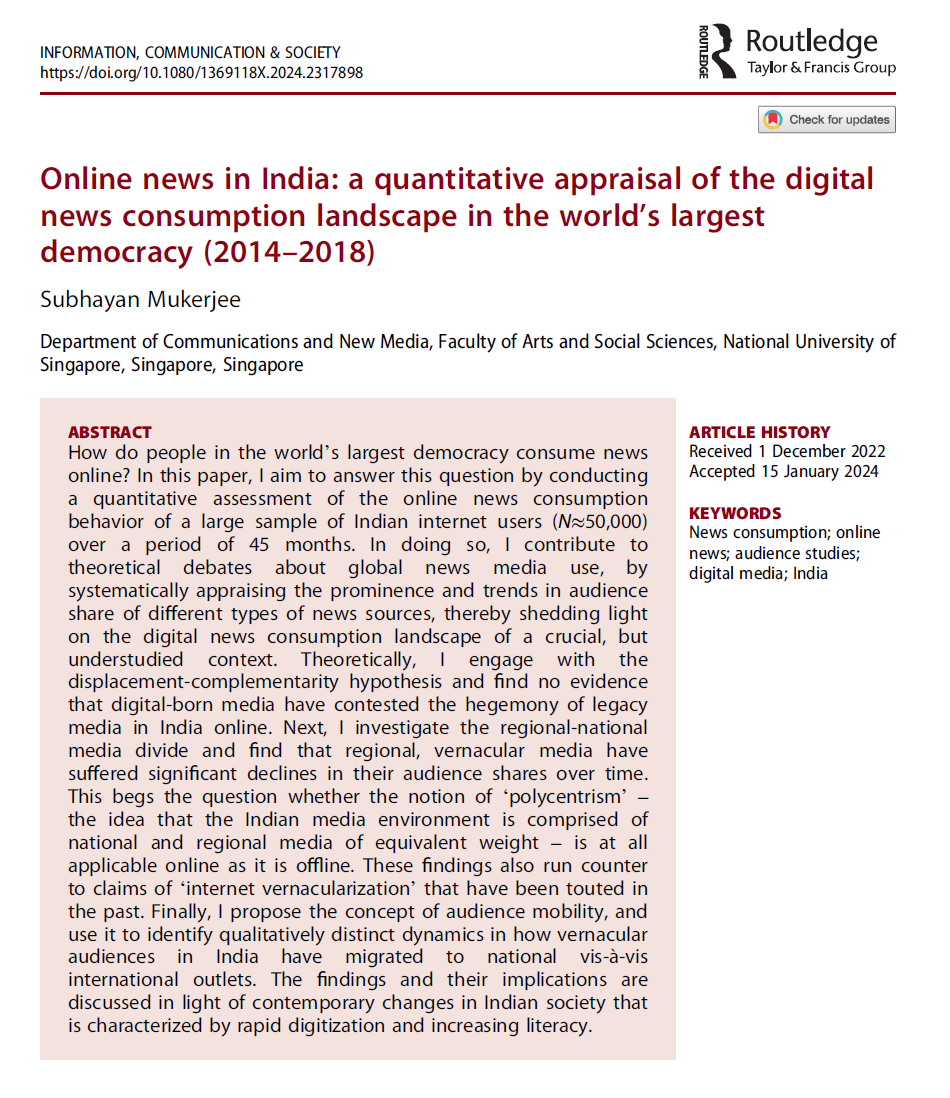
<p><img src="/assets/images/taiwan.jpg" alt="Taipei skyline" /></p>]]></content><author><name>Subhayan Mukerjee</name><email>mail@subhayan.com</email></author><category term="science" /><category term="social science" /><category term="society" /><category term="lecture" /><summary type="html"><![CDATA[I was invited to a workshop titled “Computing Society” held at the Institute of Sociology of Academia Sinica, Taiwan to deliver a talk about my research in particular and the future of computational social science in general. My talk was titled “Informational Asymmetries in the Production and Consumption of Digital Media” (slide deck / recording (from around 50 minutes)).]]></summary></entry><entry><title type="html">New Publication in Information, Communication &amp;amp; Society</title><link href="https://wrahool.github.io/posts/2024/2/ics-india-news/" rel="alternate" type="text/html" title="New Publication in Information, Communication &amp;amp; Society" /><published>2024-02-27T00:00:00-08:00</published><updated>2024-02-27T00:00:00-08:00</updated><id>https://wrahool.github.io/posts/2024/2/ics-india-news</id><content type="html" xml:base="https://wrahool.github.io/posts/2024/2/ics-india-news/"><![CDATA[<p>Last week, the empirical findings from my Ph.D. dissertation was published by <em>Information, Communication &amp; Society</em>. In this paper, I introduce a concept called “Audience Mobility” to investigate longitudinal changes in India’s online news consumption landscape. It’s hard to find journals willing to publish research which is ostensibly about non-Western contexts, and so I’m glad that after several rejections for over 2 years, this piece found utterance at ICS.</p>

<p>Find it <a href="https://www.tandfonline.com/doi/full/10.1080/1369118X.2024.2317898">here</a>.</p>

<p><img src="/assets/images/ics-india.png" alt="ics metrics screengrab" /></p>]]></content><author><name>Subhayan Mukerjee</name><email>mail@subhayan.com</email></author><category term="research" /><category term="personal" /><category term="publication" /><summary type="html"><![CDATA[Last week, the empirical findings from my Ph.D. dissertation was published by Information, Communication &amp; Society. In this paper, I introduce a concept called “Audience Mobility” to investigate longitudinal changes in India’s online news consumption landscape. It’s hard to find journals willing to publish research which is ostensibly about non-Western contexts, and so I’m glad that after several rejections for over 2 years, this piece found utterance at ICS.]]></summary></entry><entry><title type="html">SICSS-Singapore is back!</title><link href="https://wrahool.github.io/posts/2024/2/sicss-singapore-2024/" rel="alternate" type="text/html" title="SICSS-Singapore is back!" /><published>2024-02-10T00:00:00-08:00</published><updated>2024-02-10T00:00:00-08:00</updated><id>https://wrahool.github.io/posts/2024/2/sicss-singapore-2024</id><content type="html" xml:base="https://wrahool.github.io/posts/2024/2/sicss-singapore-2024/"><![CDATA[<p>I am super excited that SICSS is returning to Singapore in 2024 for its THIRD edition! <a href="https://sicss.io/">SICSS</a> (Summer Institutes in Computational Social Science) is a global initiative to bring together graduate students, postdocs and early career faculty members for intensive study and interdisciplinary research in computational social science.</p>

<p>Graciously funded and hosted by the Centre for Trusted Internet and Community, SICSS-Singapore is aimed at those who wish to explore the intersection of social science and data science. For details visit the <a href="https://sicss.io/2024/singapore/">SICSS-Singapore website</a>.</p>

<p><img src="/assets/images/sicss.png" alt="SICSS" /></p>]]></content><author><name>Subhayan Mukerjee</name><email>mail@subhayan.com</email></author><category term="science" /><category term="social science" /><summary type="html"><![CDATA[I am super excited that SICSS is returning to Singapore in 2024 for its THIRD edition! SICSS (Summer Institutes in Computational Social Science) is a global initiative to bring together graduate students, postdocs and early career faculty members for intensive study and interdisciplinary research in computational social science.]]></summary></entry><entry><title type="html">Appearance on the CCS Podcast</title><link href="https://wrahool.github.io/posts/2024/2/ccs-podcast/" rel="alternate" type="text/html" title="Appearance on the CCS Podcast" /><published>2024-02-02T00:00:00-08:00</published><updated>2024-02-02T00:00:00-08:00</updated><id>https://wrahool.github.io/posts/2024/2/ccs-podcast</id><content type="html" xml:base="https://wrahool.github.io/posts/2024/2/ccs-podcast/"><![CDATA[<p>I was recently invited by Prof. Emese Domahidi (TU Ilmenau) to appear on the <a href="https://podcasters.spotify.com/pod/show/ccs-pod/">What is it about computational communication science podcast</a> to talk about the power of platforms. We (Emese, Mario Haim, and myself) talked about the increasingly pervasive role that digital platforms play in mediating our access to information and news, the importance of social media metrics, audience fragmentation, and the need for a global perspective in answering these questions. It was a fun 45 minute conversation, but in the end we were left with more questions than answers.</p>

<p>Listen to it on Spotify <a href="https://open.spotify.com/episode/5RTEyrycOScYn0fJLCd3Qs">here</a></p>

<p><a href="https://open.spotify.com/episode/5RTEyrycOScYn0fJLCd3Qs"><img src="/assets/images/ccs-podcast.png" alt="The CCS Podcast" /></a></p>]]></content><author><name>Subhayan Mukerjee</name><email>mail@subhayan.com</email></author><category term="podcast" /><category term="digital media" /><category term="computational social science" /><summary type="html"><![CDATA[I was recently invited by Prof. Emese Domahidi (TU Ilmenau) to appear on the What is it about computational communication science podcast to talk about the power of platforms. We (Emese, Mario Haim, and myself) talked about the increasingly pervasive role that digital platforms play in mediating our access to information and news, the importance of social media metrics, audience fragmentation, and the need for a global perspective in answering these questions. It was a fun 45 minute conversation, but in the end we were left with more questions than answers.]]></summary></entry><entry><title type="html">ICA Pre-Conference on Journalism and Computation in Singapore!</title><link href="https://wrahool.github.io/posts/2024/1/ica-preconf/" rel="alternate" type="text/html" title="ICA Pre-Conference on Journalism and Computation in Singapore!" /><published>2024-01-10T00:00:00-08:00</published><updated>2024-01-10T00:00:00-08:00</updated><id>https://wrahool.github.io/posts/2024/1/ica-preconference</id><content type="html" xml:base="https://wrahool.github.io/posts/2024/1/ica-preconf/"><![CDATA[<p>I am super excited to announce that my colleagues and I are organising an ICA preconference titled <a href="https://fass.nus.edu.sg/cnm/ica-2024/">“A Computational Turn in Journalism: Opportunities and Challenges in a Cross-Dsiciplinary Field”</a> in Singapore! We welcome submissions from those who are conducting research at the intersection of computational methods and journalism. Read the full CFP <a href="https://fass.nus.edu.sg/cnm/ica-2024/">here</a> and submit your abstracts by January 26!</p>

<p><img src="/assets/images/ica-preconf.png" alt="ICA Preconference" /></p>]]></content><author><name>Subhayan Mukerjee</name><email>mail@subhayan.com</email></author><category term="journalism" /><category term="preconference" /><category term="computational social science" /><summary type="html"><![CDATA[I am super excited to announce that my colleagues and I are organising an ICA preconference titled “A Computational Turn in Journalism: Opportunities and Challenges in a Cross-Dsiciplinary Field” in Singapore! We welcome submissions from those who are conducting research at the intersection of computational methods and journalism. Read the full CFP here and submit your abstracts by January 26!]]></summary></entry><entry><title type="html">From Fort Canning to the Ledikeni</title><link href="https://wrahool.github.io/posts/2024/1/canning/" rel="alternate" type="text/html" title="From Fort Canning to the Ledikeni" /><published>2024-01-05T00:00:00-08:00</published><updated>2024-01-05T00:00:00-08:00</updated><id>https://wrahool.github.io/posts/2024/1/canning</id><content type="html" xml:base="https://wrahool.github.io/posts/2024/1/canning/"><![CDATA[<p>Fort Canning is perhaps one of Singapore’s best known landmarks. A verdant hill in Central Singapore steeped in centuries of history, it served as seat of Malay royalty in the medieval ages, was the site of the signing of the Singapore Treaty in the 1819, and the setting of what was, according to Churchill, the most ignominious surrender in the history of the British empire, in 1942.</p>

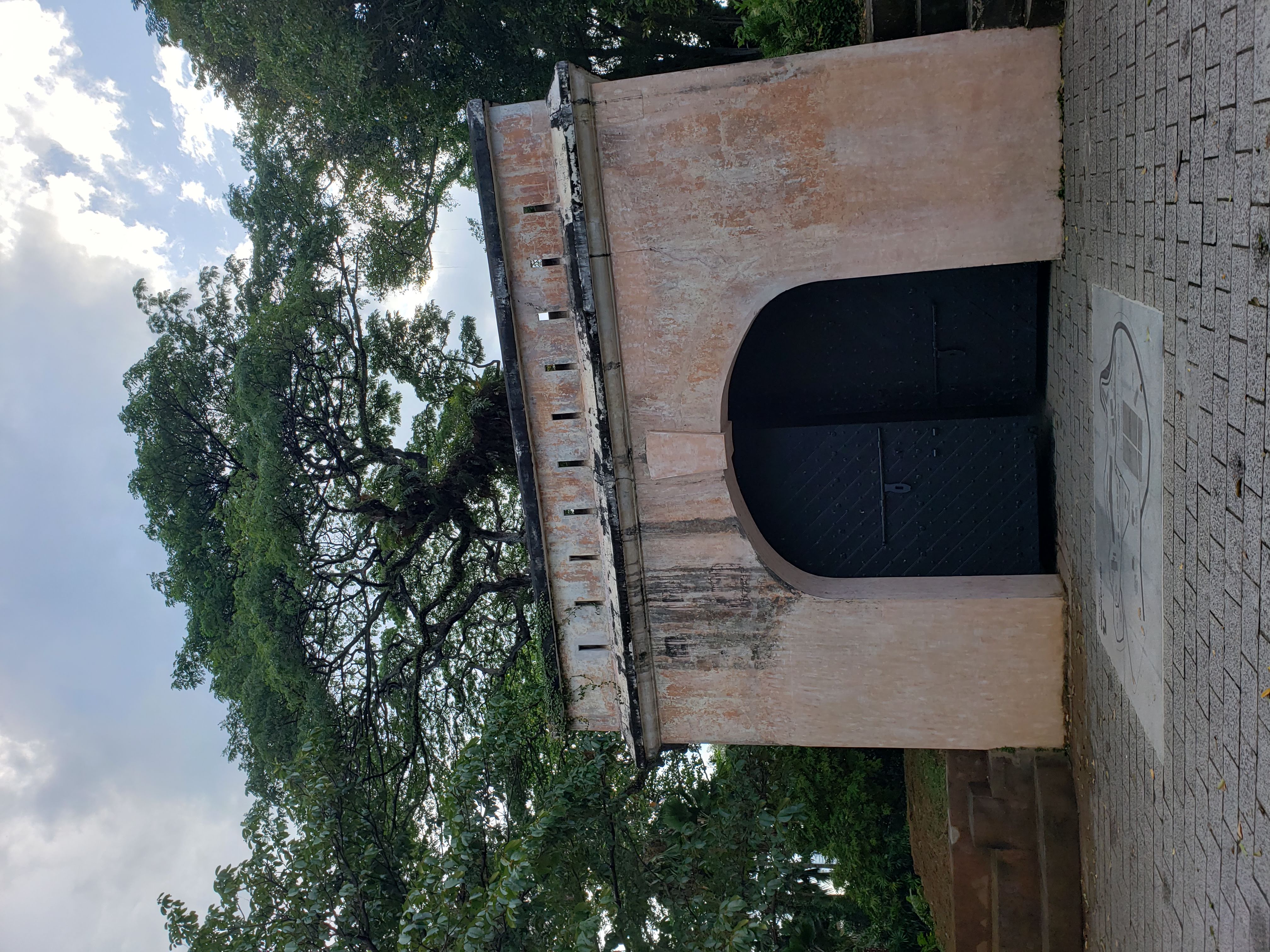
<p><img src="/assets/images/fort-canning.jpg" alt="Fort Canning gate" width="300" /></p>

<p><span style="font-size: 14px; line-height: 1;">The Gate of Fort Canning</span></p>

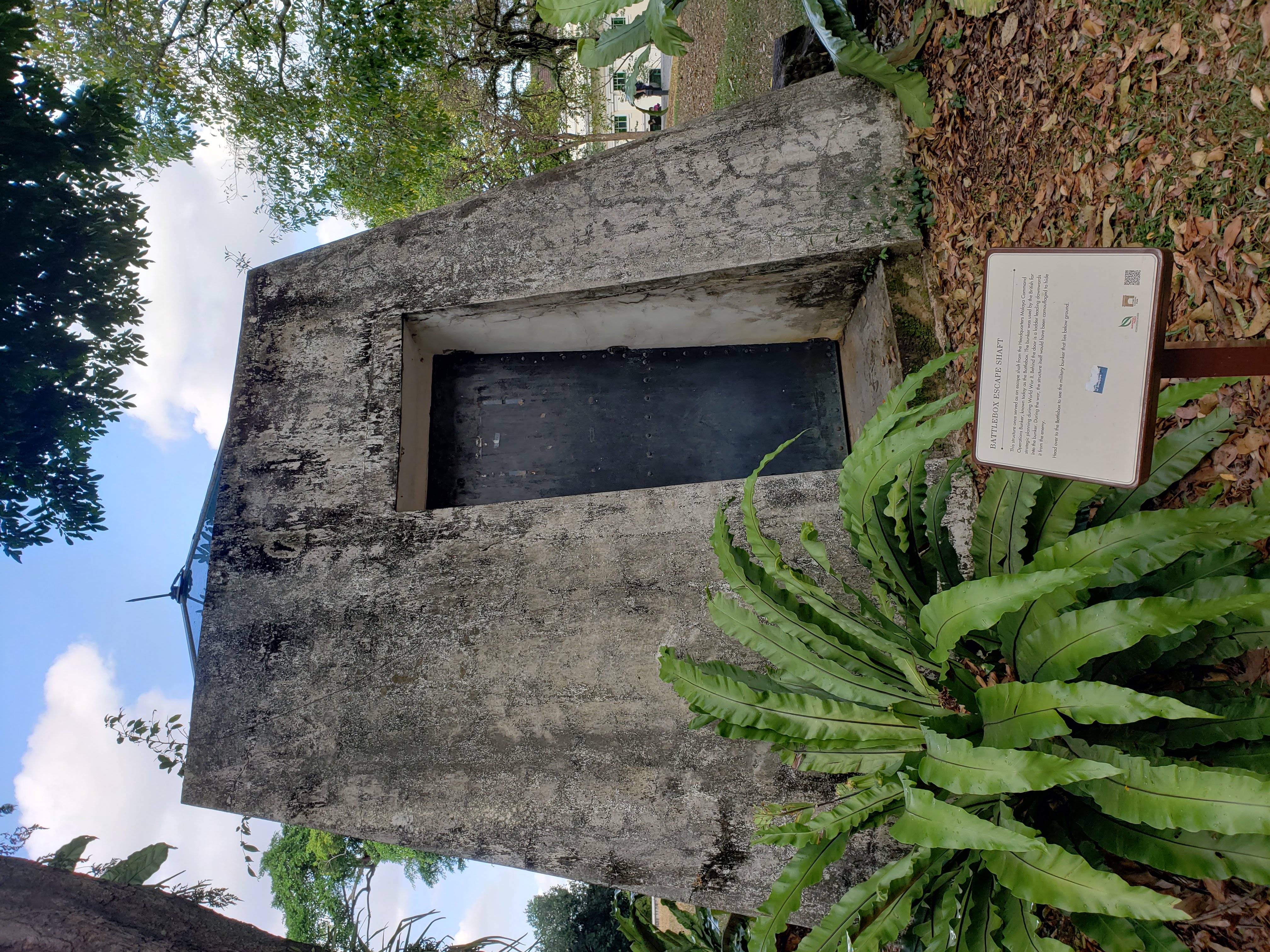
<p><img src="/assets/images/battlebox-canning.jpg" alt="Fort Canning bunker" width="300" /></p>

<p><span style="font-size: 14px; line-height: 1;">The bunker at Fort Canning where the British surrendered to the Japanese in 1942</span></p>

<p>The name Canning would be familiar to many Indians, especially those from West Bengal. It was, after all, the same <a href="https://en.wikipedia.org/wiki/Charles_Canning,_1st_Earl_Canning">Lord Charles Canning</a>, who was the Governor General of India during the Revolt of 1857 and the first Viceroy of British India immediately after. Today, there is a <a href="https://maps.app.goo.gl/K7vXBdBdFruTTzdY7">Canning Street</a> in Central Kolkata, and even a <a href="https://en.wikipedia.org/wiki/Canning,_South_24_Parganas">town in the South 24th Parganas district of West Bengal</a> that carries the same name. In part due to the spread and influence of the British empire in the 19th century, Lord Canning was also involved in arbitrating in matters in far off Africa, upholding a will that led to the split of the Sultanate of Oman into the Sultanate of Oman and the Sultanate of Zanzibar.</p>

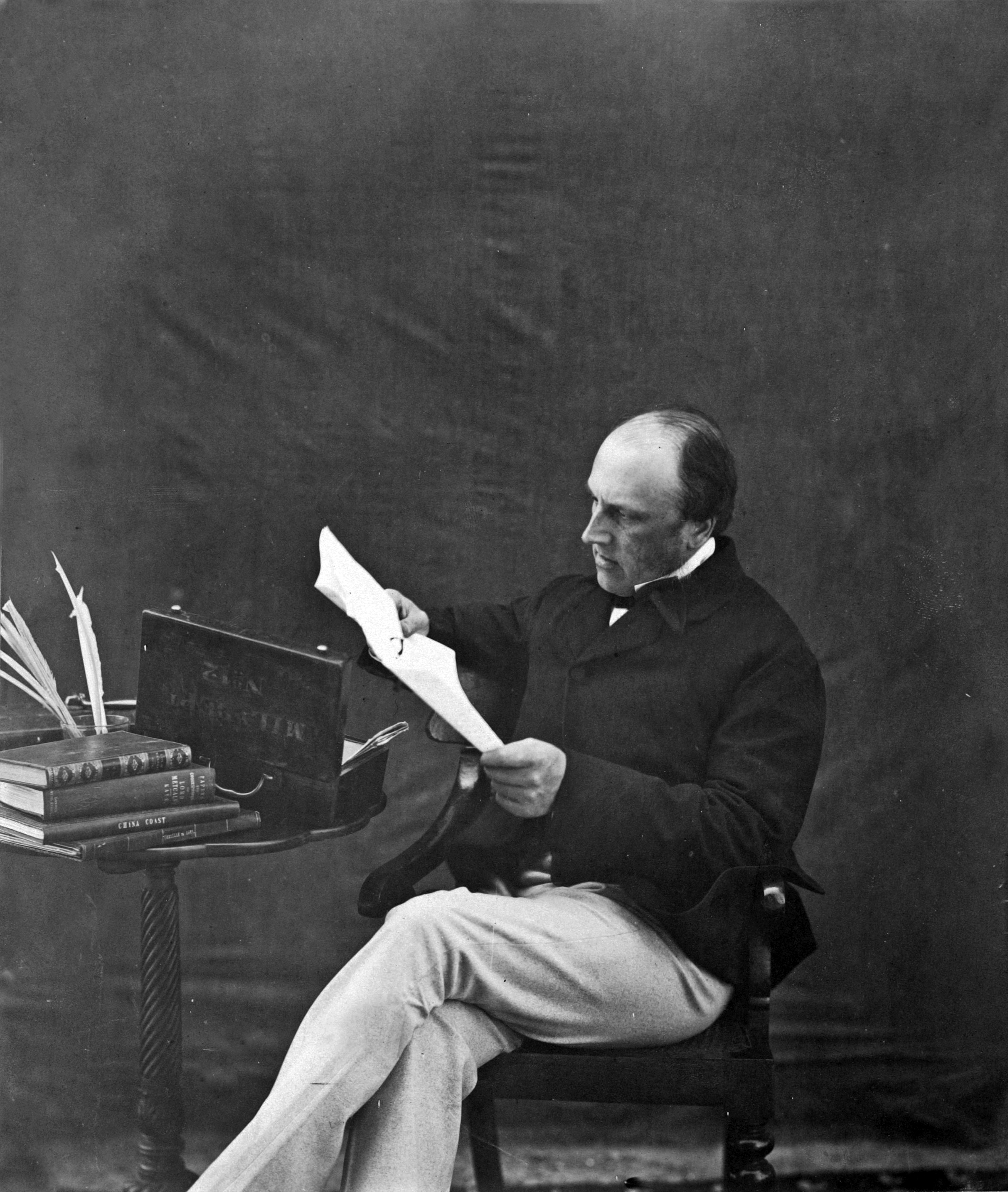
<p><img src="/assets/images/lord-canning.jpg" alt="Lord Canning" width="300" /></p>

<p><span style="font-size: 14px; line-height: 1;">Lord Canning, 1860 (source: Wikipedia)</span></p>

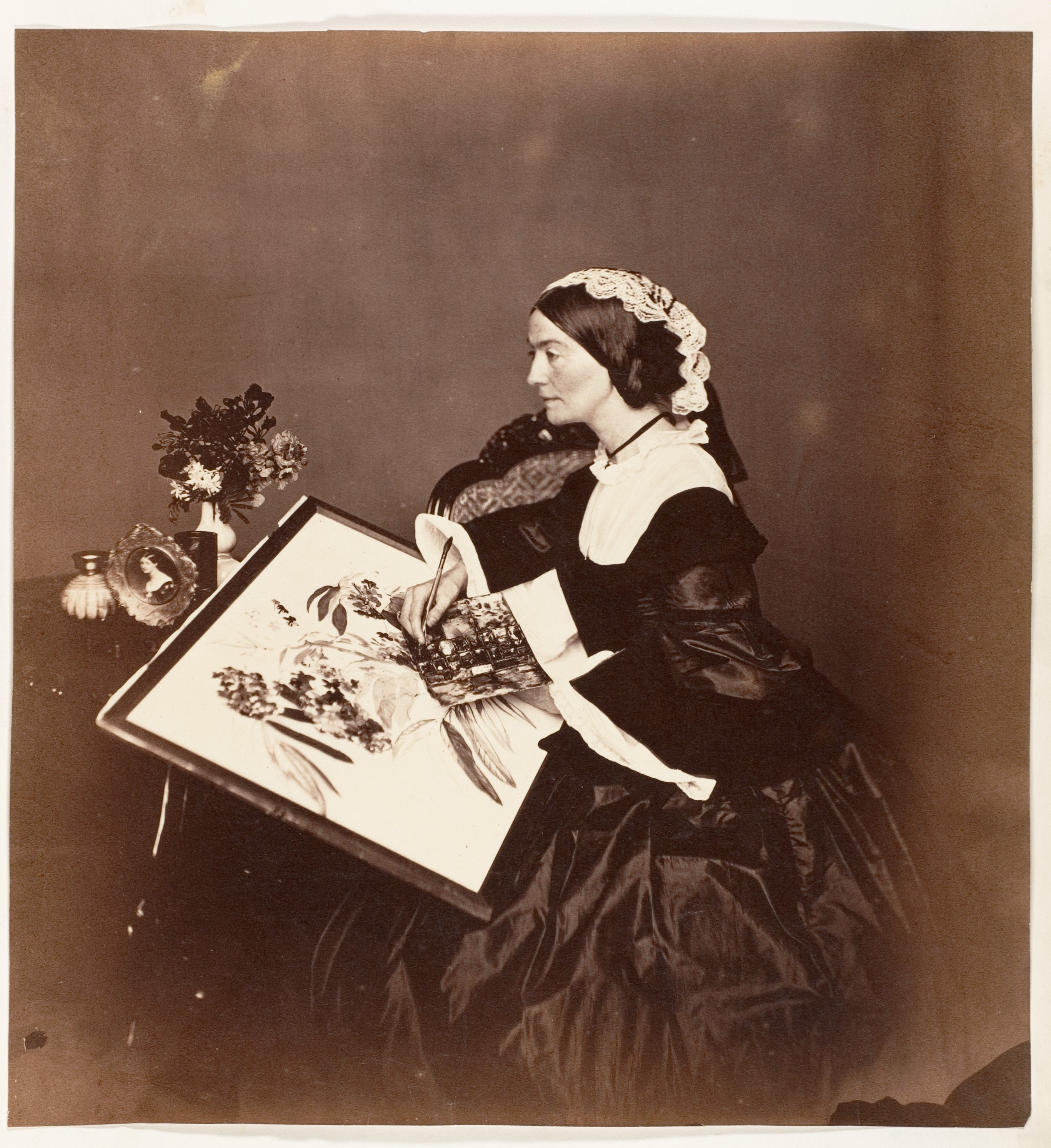
<p>Unbeknownst to many, one of the lesser known references to Canning lies hidden within the name of an unassuming confectionery in West Bengal. Legend has it that 19th century Bengali confectioners prepared a fried sweetmeat using chhena and flour in honour of Countess Charlotte Canning, the wife of Lord Canning. This sweetmeat, similar in form and structure to the more popular pantua and its North Indian cousin, the gulabjamun, became one of her favourite desserts. It was, therefore, given the name “Lady Canning” - which eventually got mangled by the Bengali mouth, both literally and figuratively, to “Ledikeni” - a moniker it continues to be known by, today.</p>

<p><img src="/assets/images/lady-canning.jpg" alt="Lady Canning" width="300" /></p>

<p><span style="font-size: 14px; line-height: 1;">Painting of Lady Canning by H Hering in Calcutta, 1861 (source: Wikipedia)</span></p>]]></content><author><name>Subhayan Mukerjee</name><email>mail@subhayan.com</email></author><category term="history" /><category term="India" /><category term="Singapore" /><summary type="html"><![CDATA[Fort Canning is perhaps one of Singapore’s best known landmarks. A verdant hill in Central Singapore steeped in centuries of history, it served as seat of Malay royalty in the medieval ages, was the site of the signing of the Singapore Treaty in the 1819, and the setting of what was, according to Churchill, the most ignominious surrender in the history of the British empire, in 1942.]]></summary></entry><entry><title type="html">Invited Seminar at the Agency for Science, Technology and Research (A*STAR)</title><link href="https://wrahool.github.io/posts/2023/11/astar-seminar/" rel="alternate" type="text/html" title="Invited Seminar at the Agency for Science, Technology and Research (A*STAR)" /><published>2023-11-20T00:00:00-08:00</published><updated>2023-11-20T00:00:00-08:00</updated><id>https://wrahool.github.io/posts/2023/11/astar-seminar</id><content type="html" xml:base="https://wrahool.github.io/posts/2023/11/astar-seminar/"><![CDATA[<p>I was invited by <a href="https://www.a-star.edu.sg/">A*STAR (Agency for Science, Technology and Research)</a>, Singapore’s foremost public sector research agency, to present my research at their Social Science &amp; Technology Seminar Series. In my talk, titled “Informational Disparities in the Landscape of News Consumption and Production on Digital Platforms,” I knit together several recently concluded research projects to discuss the evolving dynamics between digital media and their audiences, and their implications for the future.</p>

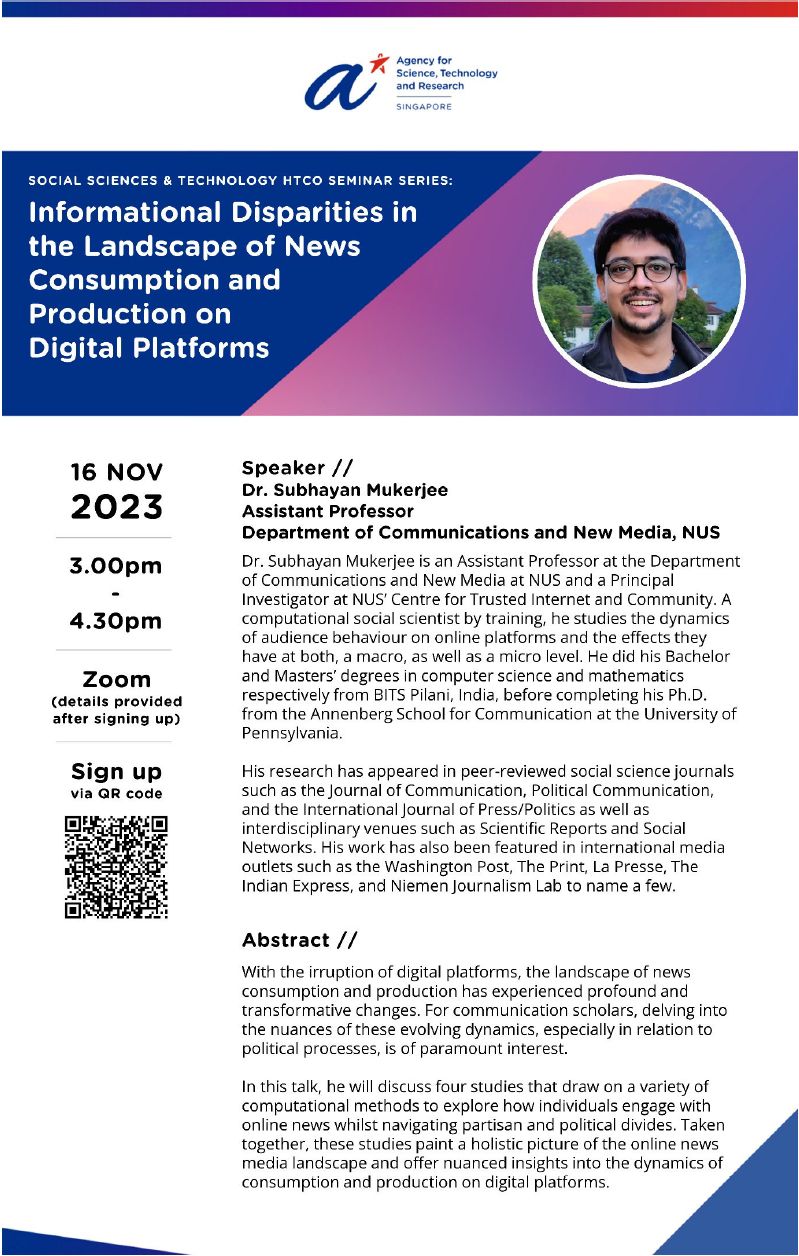
<p><img src="/assets/images/astar-seminar.jpg" alt="ASTAR Seminar" /></p>]]></content><author><name>Subhayan Mukerjee</name><email>mail@subhayan.com</email></author><category term="media studies" /><category term="research" /><category term="social science" /><category term="seminar" /><summary type="html"><![CDATA[I was invited by A*STAR (Agency for Science, Technology and Research), Singapore’s foremost public sector research agency, to present my research at their Social Science &amp; Technology Seminar Series. In my talk, titled “Informational Disparities in the Landscape of News Consumption and Production on Digital Platforms,” I knit together several recently concluded research projects to discuss the evolving dynamics between digital media and their audiences, and their implications for the future.]]></summary></entry><entry><title type="html">Seminar at the Centre for Trusted Internet and Community</title><link href="https://wrahool.github.io/posts/2023/10/ctic-seminar/" rel="alternate" type="text/html" title="Seminar at the Centre for Trusted Internet and Community" /><published>2023-10-09T00:00:00-07:00</published><updated>2023-10-09T00:00:00-07:00</updated><id>https://wrahool.github.io/posts/2023/10/ctic-seminar</id><content type="html" xml:base="https://wrahool.github.io/posts/2023/10/ctic-seminar/"><![CDATA[<p>I delivered a public seminar at the <a href="https://ctic.nus.edu.sg/">NUS Centre for Trusted Internet and Community</a> where I talked about my recent research on metrics and journalism that was <a href="https://www.subhayan.com/posts/2023/4/joc-metrics/">published in the Journal of Communication</a>.</p>

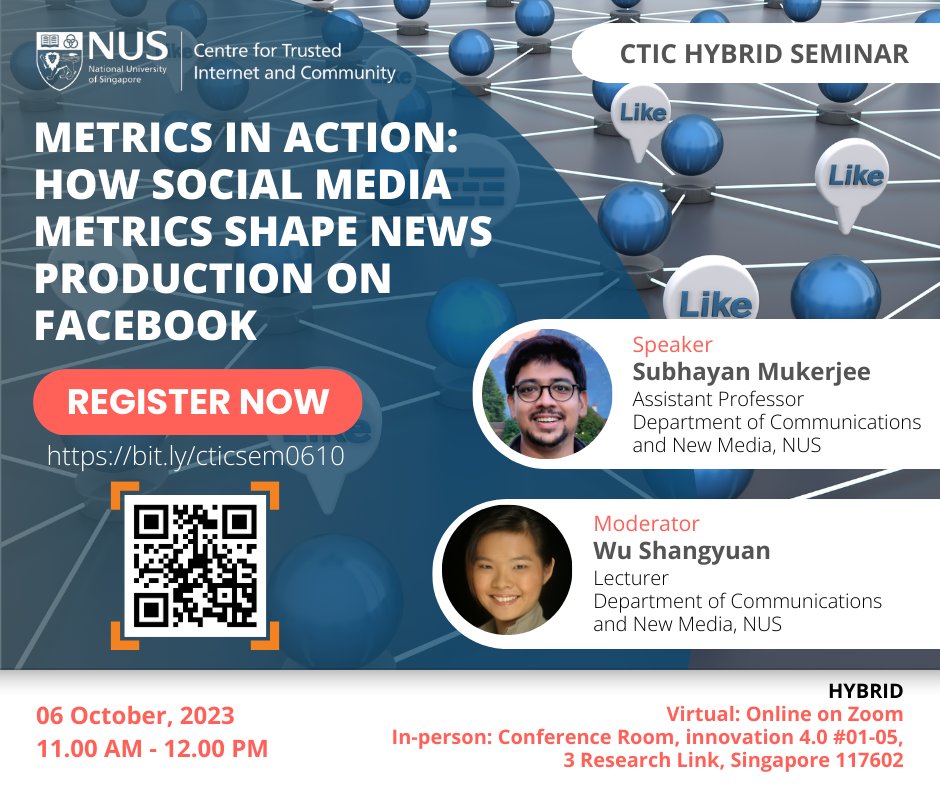
<p>The session was moderated by my NUS colleague <a href="https://profile.nus.edu.sg/fass/cnmws/">Dr. Shangyuan Wu</a> and attended by students, other NUS staff, and members of the public.</p>

<p><img src="/assets/images/ctic-metrics.jpg" alt="CTIC Seminar" /></p>]]></content><author><name>Subhayan Mukerjee</name><email>mail@subhayan.com</email></author><category term="media studies" /><category term="journalism" /><category term="research" /><category term="seminar" /><summary type="html"><![CDATA[I delivered a public seminar at the NUS Centre for Trusted Internet and Community where I talked about my recent research on metrics and journalism that was published in the Journal of Communication.]]></summary></entry></feed>